
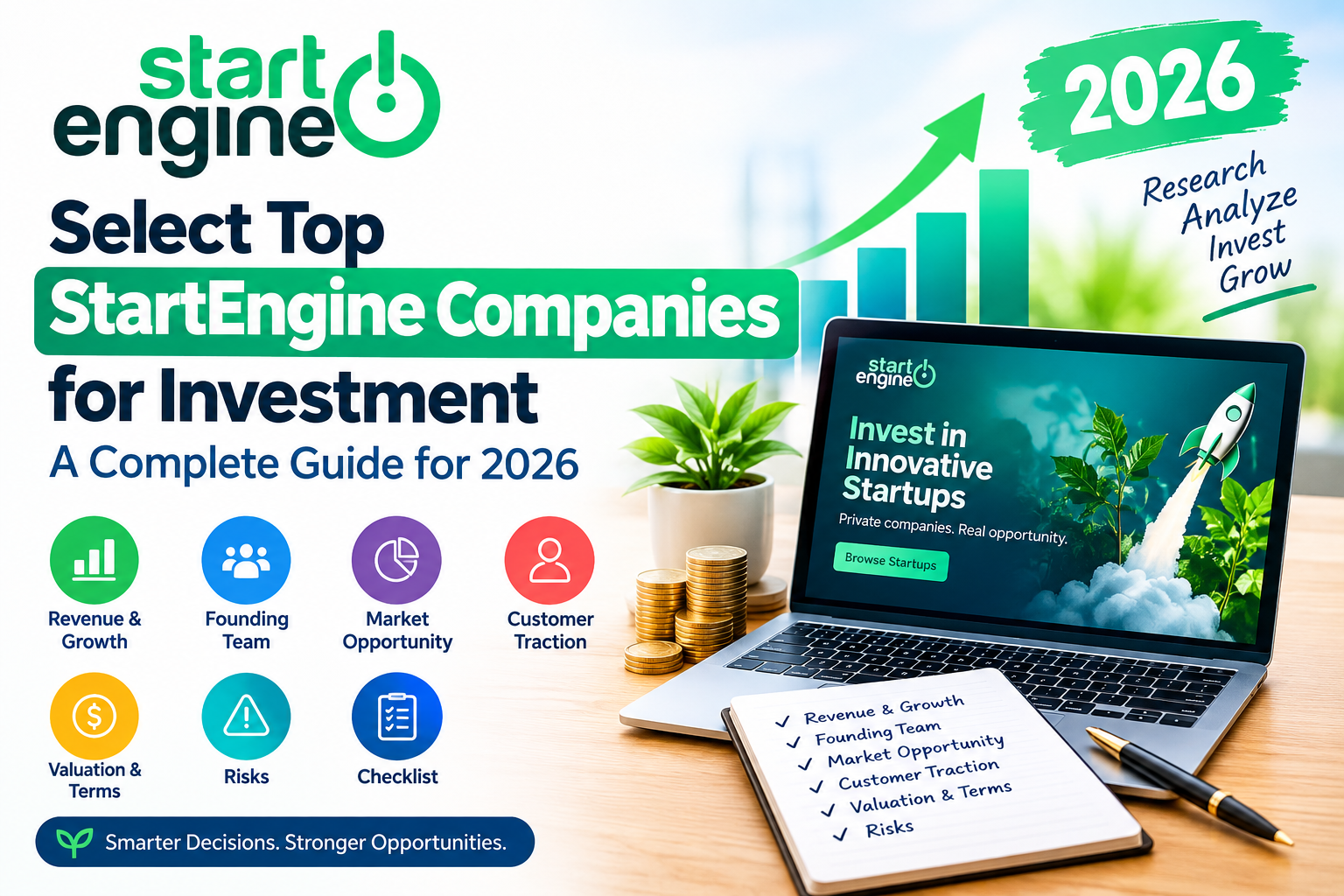
Select Top StartEngine Companies for Investment: A Complete Guide for 2026
Investing in startups can provide access to businesses at an early stage of their growth, but choosing the right opportunity requires careful research. StartEngine gives investors access to a wide range of private-company investment opportunities, including Regulation Crowdfunding offerings and, for eligible investors, selected pre-IPO opportunities.
But how do you decide which StartEngine companies deserve a closer look?
This guide explains how to evaluate StartEngine companies, compare startup valuations, analyze revenue and growth, examine investment terms, understand risks, and learn from real StartEngine campaign examples.
Important: This article is for educational purposes only and is not financial advice. Private startup investments are speculative and can result in the loss of your entire investment.
What You’ll Learn
In this guide, you’ll learn:
- How StartEngine investments work
- How to identify promising companies
- Which financial metrics to analyze
- How to evaluate startup valuations
- How customer traction can influence your decision
- Examples of StartEngine companies and campaigns
- How to compare investment opportunities
- Common risks investors should understand
- A practical startup-investment checklist
What Is StartEngine?
StartEngine is an investment platform that provides access to private-company offerings.
Depending on the offering, investors may receive equity or other types of securities. Regulation Crowdfunding offerings have specific restrictions and risks, and the securities are generally not publicly traded.
StartEngine’s investor education materials specifically warn that startup investing is highly speculative, that investors can lose their entire investment, and that private securities can be illiquid.
That means investors should think about StartEngine differently from a normal stock brokerage account.
How to Select the Best StartEngine Companies
There isn’t one metric that can identify the “best” startup.
Instead, evaluate each company using several factors.
1. Revenue and Revenue Growth
Revenue is one of the most useful starting points when evaluating an operating startup.
Look at:
- Current annual revenue
- Revenue growth
- Recurring revenue
- Gross margin
- Customer growth
- Revenue per customer
- Repeat purchases
- Customer retention
A company with increasing revenue may demonstrate stronger market demand than a company that has only a concept or prototype.
However, revenue alone doesn’t make an investment attractive.
A company could have significant revenue while still losing money or carrying an expensive valuation.
Example
Suppose:
| Company | Annual Revenue | Valuation | Revenue Multiple |
|---|---|---|---|
| Startup A | $10M | $50M | 5× |
| Startup B | $2M | $100M | 50× |
Startup B may need substantially stronger future growth to justify its valuation.
Don’t simply ask, “How fast is the company growing?”
Also ask:
“How much am I paying for that growth?”
2. Evaluate the Founding Team
A startup’s team can be as important as its product.
Research:
- Founder experience
- Previous companies
- Industry expertise
- Technical experience
- Previous exits
- Fundraising experience
- Leadership team
- Ability to execute the business plan
StartEngine says its company eligibility process considers factors including the company, product or service, customer engagement, team, founder experience, industry, offering terms and market traction.
However, platform screening should never replace your own due diligence.
3. Analyze the Market Opportunity
A startup may have an excellent product but operate in a very small market.
Look at:
TAM — Total Addressable Market
SAM — Serviceable Available Market
SOM — Serviceable Obtainable Market
A useful investment question is:
Can this company realistically become large enough to justify its current valuation?
Industries investors may encounter on startup platforms include:
- Artificial intelligence
- Robotics
- Fintech
- Healthcare
- Climate technology
- Consumer products
- Food and beverage
- SaaS
- Cybersecurity
- Manufacturing
- Education technology
A large market is helpful, but competition and execution still matter.
4. Study Customer Traction
Customer behavior can provide valuable evidence that a product is solving a real problem.
Look for:
- Paying customers
- Repeat purchases
- Subscription growth
- Enterprise contracts
- Partnerships
- Customer retention
- Product reviews
- Increasing order volume
For example, StartEngine’s previous Tanoshi offering reported more than $3 million in revenue and more than 15,000 computers sold at the time of its campaign.
Those numbers demonstrate measurable customer traction.
However, historical traction doesn’t guarantee future success.
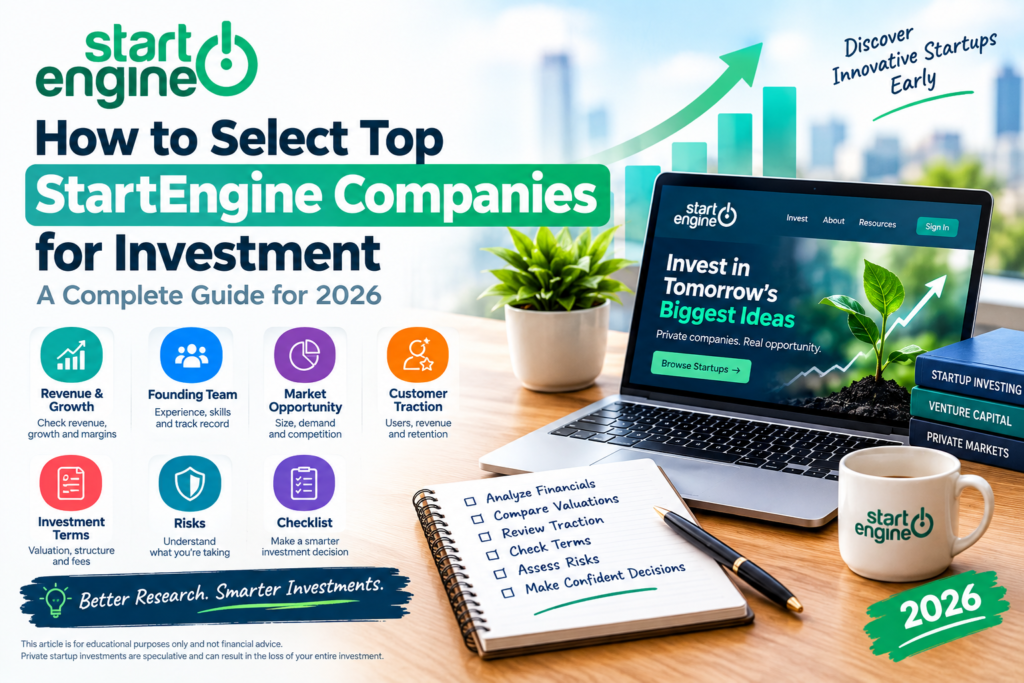
5. Compare the Valuation
Valuation is one of the most important parts of startup investing.
A great company can still be a poor investment if the valuation is excessively high.
Consider:
Valuation ÷ Revenue = Revenue Multiple
Also compare:
- Growth rate
- Gross margin
- Market size
- Competitors
- Cash position
- Debt
- Previous financing
- Expected dilution
Simple valuation framework
| Metric | What to Ask |
|---|---|
| Revenue | Is the business generating real sales? |
| Growth | Is revenue increasing? |
| Margin | Can the company eventually become profitable? |
| Valuation | Is the price reasonable relative to growth? |
| Cash | How long can the company operate? |
| Debt | Does the company have significant obligations? |
| Dilution | Could future fundraising reduce ownership? |
6. Understand the Investment Terms
Never invest based only on the company’s story.
Read the actual offering documents.
Pay attention to:
- Security type
- Share price
- Valuation
- Ownership percentage
- Voting rights
- Liquidation preferences
- Conversion terms
- Minimum investment
- Investor rights
- Dilution provisions
- Use of funds
StartEngine’s investor education materials emphasize that investors are responsible for conducting their own due diligence and understanding the risks and terms of each investment.
StartEngine Company Examples and Case Studies
The following examples are not investment recommendations. They are useful because they show different ways investors can analyze startup opportunities.
Case Study 1: Kara Water
Kara Water provides atmospheric water-generation technology designed to produce drinking water from air.
According to StartEngine’s published case study, Kara Water’s previous Regulation Crowdfunding campaign closed on March 7, 2025, after raising more than $1.6 million from 1,555 investors. StartEngine reported that more than 80% of the dollars invested came from its community.
What investors can learn
Kara Water illustrates how investors can examine:
- Product differentiation
- Investor demand
- Capital raised
- Customer engagement
- Potential market size
- Real-world product adoption
Importantly, a successful fundraising campaign does not mean the underlying investment will produce a positive return.
Research lesson: Separate fundraising success from investment performance.
Case Study 2: Tanoshi
Tanoshi focuses on educational technology products designed for children.
Its previous StartEngine offering reported more than $3 million in revenue and more than 15,000 computers sold at the time of the offering. The company also highlighted retail sales and media exposure.
What investors can learn
This example demonstrates the importance of examining:
- Actual product sales
- Revenue
- Distribution
- Customer demand
- Retail relationships
- Gross-margin trends
- Marketing costs
The lesson is simple:
Look for evidence that customers are actually buying the product.
Case Study 3: The Cumin Club
The Cumin Club is a food company focused on ready-to-eat Indian meals.
Its previous StartEngine campaign reported 1.8 million meals served and $10 million in lifetime revenue, while its 2023 revenue was reported as $3.6 million. The campaign also disclosed previous funding from venture investors.
What investors can learn
The Cumin Club provides an example of analyzing:
- Lifetime revenue
- Product volume
- Market opportunity
- Previous investors
- Expansion plans
- Retail strategy
The company also disclosed that some of its expansion plans were forward-looking goals rather than guarantees.
Research lesson: Always distinguish historical results from management projections.
Case Study 4: NOVICA
NOVICA is a marketplace connecting consumers with artisans.
Its 2026 StartEngine offering highlights its marketplace model, technology-driven expansion, artisan infrastructure and strategic relationships. The current offering also discusses customer loyalty and an NPS of 76.
What investors can learn
For a marketplace business, investors should examine:
- Number of buyers
- Number of sellers
- Repeat purchase rate
- Customer acquisition cost
- Average order value
- Gross merchandise volume
- Marketplace margins
- International expansion
- Technology investment
Marketplace businesses can have attractive network effects, but they also face significant competition.
A Useful StartEngine Investment Comparison Chart
You can create a simple scoring model before researching individual offerings.
| Factor | Weight | Questions |
|---|---|---|
| Revenue | 20% | Does the company generate meaningful sales? |
| Growth | 15% | Is revenue growing? |
| Valuation | 20% | Is the valuation reasonable? |
| Team | 10% | Does management have relevant experience? |
| Market | 10% | Is the opportunity large enough? |
| Customers | 10% | Is there strong customer traction? |
| Competition | 5% | Does the company have an advantage? |
| Financial health | 5% | How much cash and debt does it have? |
| Terms | 5% | Are the investment terms attractive? |
Important: This is an educational framework, not a recommendation or a guarantee of investment performance.
Suggested Infographic: How to Evaluate a StartEngine Company
For a blog infographic, use this simple five-step visual:
STARTENGINE COMPANY
↓
1. Revenue
Real sales and growth
↓
2. Customers
Traction and retention
↓
3. Valuation
Price compared with fundamentals
↓
4. Competitive Advantage
Technology, brand, patents or network effects
↓
5. Investment Terms
Security, dilution, rights and restrictions
↓
RESEARCH BEFORE INVESTING
This type of infographic can make the article easier to understand and gives readers a quick framework they can save or share.
Suggested Chart: Startup Evaluation Scorecard
A visual chart can also compare companies using the same criteria.
For example:
| Category | Company A | Company B | Company C |
|---|---|---|---|
| Revenue | 8/10 | 6/10 | 9/10 |
| Growth | 9/10 | 7/10 | 6/10 |
| Valuation | 6/10 | 8/10 | 5/10 |
| Team | 8/10 | 9/10 | 7/10 |
| Market | 9/10 | 7/10 | 8/10 |
| Customer traction | 8/10 | 6/10 | 9/10 |
Do not publish invented scores for real companies.
Instead, use this framework only after collecting and verifying the relevant data from current offering documents.
StartEngine Private and Pre-IPO Opportunities
StartEngine also provides access to selected private-market opportunities for eligible investors.
StartEngine has described opportunities involving companies such as OpenAI, Perplexity and Databricks through StartEngine Private. These opportunities are different from ordinary Regulation Crowdfunding investments and have their own eligibility, minimum-investment and risk considerations.
Investors should therefore avoid comparing a pre-IPO opportunity directly with a small startup offering without first understanding the differences in:
- Company stage
- Valuation
- Security structure
- Investor eligibility
- Minimum investment
- Liquidity
- Disclosure
- Risk
Major Risks of StartEngine Investing
Startup investing can be exciting, but it carries substantial risks.
1. Total Loss
StartEngine warns that investors may lose their entire investment.
2. Illiquidity
Private securities are generally not traded like public stocks.
StartEngine states that securities sold through its Regulation Crowdfunding platform are restricted and not publicly traded. Investors generally face resale restrictions, including a typical one-year restriction with certain exceptions.
3. Business Failure
A startup can fail because of:
- Poor execution
- Lack of customers
- Competition
- Cash shortages
- Regulatory changes
- Economic conditions
- Technology problems
- Management problems
4. Dilution
Future fundraising may reduce your percentage ownership.
5. No Guaranteed Exit
An investment doesn’t guarantee:
- IPO
- Acquisition
- Profit
- Dividend
- Share buyback
- Secondary-market liquidity
6. Projections May Not Become Reality
Management forecasts are estimates.
Always separate:
Historical performance
from
Future projections
This distinction is particularly important when evaluating startup campaigns.
StartEngine Investment Due-Diligence Checklist
Before investing, ask yourself:
Business
- What does the company sell?
- Who are its customers?
- What problem does it solve?
- Why will customers continue buying?
Financials
- How much revenue does it generate?
- Is revenue growing?
- Is the company profitable?
- How much cash does it have?
- How quickly is it spending money?
Market
- How large is the market?
- Who are the competitors?
- What makes this company different?
Management
- Who founded the company?
- What relevant experience do they have?
- Have they built companies before?
Investment
- What security am I buying?
- What valuation am I paying?
- Could future fundraising dilute me?
- What are my investor rights?
- How long could my money remain locked up?
Risk
- Could I afford to lose 100% of this investment?
- Is this investment appropriate for my overall portfolio?
- Have I read the official offering documents?
Where to Verify StartEngine Investment Information
For current information, use the company’s official StartEngine offering page and its latest offering documents rather than relying on old articles or social-media posts.
Browse StartEngine investment opportunities
Read StartEngine’s Investor Education Guide
Review NOVICA’s current StartEngine offering
Read the Kara Water case study
These sources are preferable when checking current terms because startup offerings can change and older campaign information may no longer represent the current opportunity.
Key Takeaways
If you’re researching StartEngine companies, don’t choose an investment simply because the company is popular or has an exciting product.
Instead:
- Check real revenue.
- Analyze revenue growth.
- Compare valuation with fundamentals.
- Research the founding team.
- Evaluate customer traction.
- Understand the competitive landscape.
- Read the complete offering documents.
- Understand dilution and investor rights.
- Separate historical results from projections.
- Understand that private investments can be illiquid.
- Never assume fundraising success means investment success.
- Only invest money you can afford to lose.
Final Thoughts
The most promising StartEngine companies are not necessarily the companies with the biggest headlines or the most impressive projections.
A better approach is to build a repeatable research process.
Look for real customers, measurable revenue, sustainable growth, experienced management, a large market, competitive advantages and reasonable investment terms.
Then compare those factors against the company’s valuation and risk.
StartEngine provides access to private investment opportunities, but StartEngine’s own investor guidance makes clear that investors must conduct their own due diligence and understand the possibility of losing their entire investment.
The goal should therefore not be to find a guaranteed winner.
The goal is to make a well-researched, risk-aware investment decision.
Disclaimer: This article is for informational and educational purposes only and does not constitute financial, investment, legal or tax advice. Private-company investments are speculative and may result in a total loss. Investment availability, valuations, financial results and offering terms can change. Always review the latest official offering documents and consider consulting an appropriately qualified professional before investing.